

Why Remodeling Contractors Keep Losing Money on Jobs They Win
Published on The Automation Journal | Booked Solid Copy
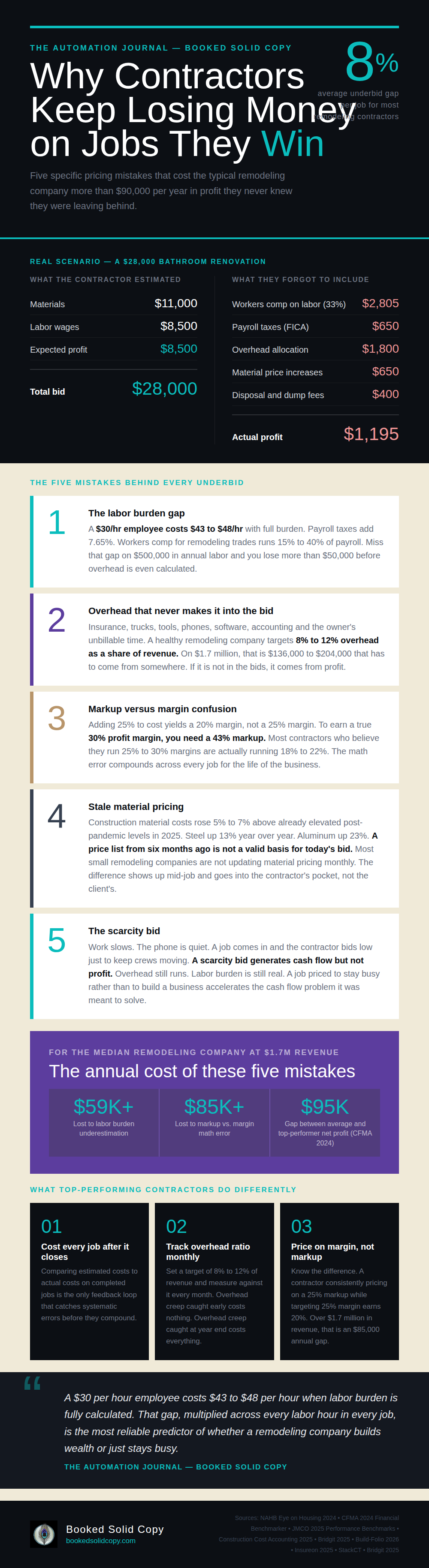
The job looked good on paper. A $28,000 bathroom renovation, a reliable client, clean scope. The contractor figured materials at $11,000, budgeted $8,500 for labor wages, and expected to pocket the remaining $8,500 as profit. A healthy margin. A good week.
By the time the last tile was set and the final payment cleared, that $8,500 had become $1,900.
Nothing went wrong on the job. No change orders, no surprises in the walls, no callbacks. The crew showed up, did the work, and left the site clean. The client was happy. The contractor was confused.
The money did not disappear because of a bad job. It disappeared because of a bad estimate.
This Is Not an Isolated Story
The typical residential remodeling firm in the United States has five employees and generates about $1.7 million in annual revenue, according to 2024 data from the National Association of Home Builders. It completes roughly 15 jobs over $10,000 per year, alongside a mix of smaller work.
At those volumes, the math on a $6,000 miscalculation per job gets ugly fast. Repeat that error across a full year of work, and the gap between what a contractor thought they were earning and what they actually earned can exceed $90,000.
The Construction Financial Management Association's 2024 Benchmarker found the average pre-tax net income for construction companies was 6.3% of revenue. Top performers managed 11.9%. For a $1.7 million remodeling company, the difference between those two figures is more than $95,000 per year in profit, sitting on the table, unclaimed.
Most of it stays unclaimed, not because contractors are bad at their trade, but because they are pricing work the way they learned to price work, which is often the way the person who taught them priced work, which was probably wrong too.
Mistake No. 1: The Labor Burden Gap
This one accounts for more lost margin than anything else, and it is the most consistently overlooked.
A carpenter earning $30 per hour does not cost $30 per hour. Not even close.
Construction Cost Accounting lays out the full picture: payroll taxes alone add 7.65% in FICA contributions. State unemployment taxes run between 1% and 10%, depending on the state and the company's claims history. Workers’ compensation for remodeling and construction trades typically falls between 15% and 40% of payroll, depending on the specific work classification.
Put those together, and a $30 per hour wage becomes an actual cost of $43 to $48 per hour before a single dollar of overhead touches it.
The specific example from construction cost accounting research makes this concrete: "If you estimate a project using a 20% overall labor burden when your actual workers’ compensation rate is 35%, you've just underbid by 15% of your labor costs. On a $50,000 labor component, that's $7,500 in lost profit."
For a $1.7 million remodeling company where labor accounts for 30% to 40% of project cost, the total labor component across all jobs runs somewhere between $510,000 and $680,000 annually. A 10-point error in labor burden estimation on that base costs the company between $51,000 and $68,000 per year in profit that never shows up anywhere because it was never priced in to begin with.
That number never appears on a profit and loss statement. It just shows up as a slow, confusing drain that the owner cannot quite explain.
Mistake No. 2: Overhead That Never Makes It Into the Bid
Ask most remodeling contractors to list their overhead, and they will name a few things. Insurance. A truck payment. Maybe a storage unit. What they rarely name is the full reality of what it costs to keep their business operating.
Build-Folio's contractor overhead guide breaks down what that actually looks like: general liability insurance, workers compensation, vehicle insurance and bonding; truck payments, fuel, maintenance, tools, trailers and equipment depreciation; rent or storage, utilities, office supplies, software subscriptions, phones and accounting; marketing, lead generation, vehicle wraps and yard signs; and the owner's salary for the time spent estimating, managing jobs and handling administration rather than swinging a hammer.
Insureon's 2025 data puts average general liability insurance for small contractors at $267 per month, workers’ compensation at $254 per month, and commercial auto at $173 per month. That is roughly $8,300 per year in insurance before the first tool leaves the truck. A company running three work vehicles adds another $9,000 to $15,000 in vehicle costs on top of that.
The JMCO 2025 Performance Benchmarks report sets a healthy overhead ratio for construction firms at 8% to 15% of revenue. On $1.7 million, that is $136,000 to $255,000 in annual overhead. That overhead does not vary based on how many jobs close in a given month. It is there whether the crew is busy or not.
When a contractor does not allocate overhead explicitly into every bid, that overhead has to come from somewhere. It comes from profit. And when there is not enough profit to cover it, it comes from the owner's personal accounts or from the business credit line, quietly compounding a problem that looks like a cash flow issue but is actually a pricing issue.
Mistake No. 3: The Markup Versus Margin Math Error
This is the most common math mistake in the industry, and it is significant.
Markup and margin are not the same calculation. Treating them as interchangeable is expensive.
ProLine Roofing CRM explains the formula clearly: profit margin is calculated as the profit divided by the selling price. Markup is calculated as the profit divided by the cost. A contractor who adds 25% to their costs is not operating at a 25% margin. They are operating at a 20% margin.
The math:
A job costs $20,000 in direct costs and overhead. The contractor adds 25% markup to arrive at a $25,000 bid. Profit is $5,000. Margin calculation: $5,000 divided by $25,000 is 20%, not 25%.
To achieve a true 30% profit margin, the contractor needs to mark up costs by approximately 43%. Most contractors who think they are running at 30% margins are actually running at somewhere between 20% and 23% because of this calculation error applied consistently across every job.
The CFMA's 2024 Benchmarker shows the industry average gross margin for general contractors hovering around 14.8%. Specialty contractors land just over 16%. The gap between those numbers and the 20% to 30% that most remodeling contractors believe they are earning is almost entirely explained by this single math error, repeated on every estimate for years.
Mistake No. 4: Stale Material Pricing
Material prices in residential construction do not stay still. They have not stayed still for several years.
Bridgit's 2025 analysis found that construction material costs had risen 5% to 7% on top of already elevated post-pandemic levels. Steel was up 13% year over year. Aluminum was up 23%. Tariff rates on construction materials hit a 40-year high in 2025, with effective rates reaching 25% to 30% on many imported goods.
A price list from six months ago is not a valid basis for a bid today. But most small remodeling companies are not updating their pricing databases monthly. They are using numbers from the last job, which used numbers from the job before that, gradually diverging from what materials actually cost until the margin is gone before the crew ever shows up.
The practical consequence appears mid-job when the contractor drives to the supplier for materials quoted at $4,200 three months earlier and pays $4,850. The job does not have a change order for that difference. It never did. The contractor absorbs it.
Construction Cost Accounting recommends updating material costs every 60 to 90 days at a minimum, and getting fresh supplier quotes for any job where material delivery extends more than 30 days from the estimate date. Most contractors do neither.
Mistake No. 5: The Scarcity Bid
This one is different from the others because it is intentional, at least in the moment.
Work slows down in January. The phone is quiet. A kitchen remodel comes in, and the contractor bids it lower than usual, not because of a math error, but because they want the job. They want crews busy. They want cash coming in.
StackCT's analysis of underbidding behavior identifies the scarcity mindset as one of the three primary causes of chronic underbidding: "If you're stuck in a scarcity mindset and nervous about not winning enough jobs, you might be tempted to bid low out of a fear of losing."
The problem is that a scarcity bid generates cash flow but not profit. The crew stays busy. The invoices get paid. The owner looks at the bank account and sees money coming in. But the overhead is still running. The labor burden is still real. The materials still cost what they cost. A job priced to keep the lights on rather than priced to build a business accelerates the exact problem the contractor was trying to avoid.
Bridgit's 2025 research on margin compression describes this dynamic across the industry: "When demand softens, contractors compete more aggressively on price, even when their costs haven't dropped." The result is a race that nobody wins, including the contractor who underbid and got the job.
What This Costs Over a Full Year
Put all five mistakes together and run them against the numbers for a typical $1.7 million remodeling company.
Labor burden gap: a 10-percentage-point error on 35% of revenue in labor costs equals $59,500 in unrecovered costs annually
Overhead not allocated: at a lean 10% overhead rate, a company not recovering overhead is absorbing $170,000 per year that should be in bids.
Markup versus margin error: underpricing by five margin points on $1.7 million in revenue equals $85,000 in lost profit.
Not all of these compounds fully. Some overlap, some are already partially priced in, and real-world numbers vary by company. But industry research consistently confirms that contractors who underbid by 8% to 12% across their project mix lose between $50,000 and $120,000 in profit per year compared to what accurate pricing would have yielded.
For a company generating $1.7 million in revenue and netting the industry average of 6.3% after taxes, that is $107,100 in net profit. The difference between what the top-performing 25% of construction companies earn at 11.9% and what the top-performing 25% of construction companies earn at 11.9% is more than $95,000. That gap is not talent. It is pricing.
What the Profitable Companies Do Differently
The JMCO 2025 benchmarking report identifies three habits that separate contractors in the top performance quartile from everyone else.
They cost jobs after they complete them, not just before they start. Comparing the estimated cost of a completed job to its actual cost creates a feedback loop that catches systematic errors before they compound. Contractors who do not do this are flying on instruments that have not been calibrated.
They know their overhead ratio and track it monthly. The target for most remodeling companies is 8% to 12% of revenue. Contractors who measure against a number can catch overhead creep before it silently consumes the margin their field crews earned on the job site.
They price on margin, not markup. The distinction is not academic. A contractor who prices consistently on a 25% markup and thinks they are running a 25% margin is actually operating at 20%, and the difference compounds across every job they complete for the life of the business.
None of this requires expensive software. It requires a consistent habit of looking at the real numbers rather than the estimated ones. A custom estimation tool built around your actual labor burden, overhead rate, and margin targets makes this consistent across every bid. See how it works.
The Number Worth Keeping
A $30 per hour employee costs $43 to $48 per hour when the labor burden is fully calculated. That gap, multiplied across every labor hour in every job, is the most reliable predictor of whether a remodeling company builds wealth or just stays busy.
Busy is not the goal. Profitable is.
Booked Solid Copy builds custom estimation and automation tools for trade contractors, with one-time fixed pricing and no monthly fees. Schedule a call to talk through your numbers.
