

What Roofing Contractors Actually Complain About (And Why It Keeps Happening)
Published on The Automation Journal | Booked Solid Copy
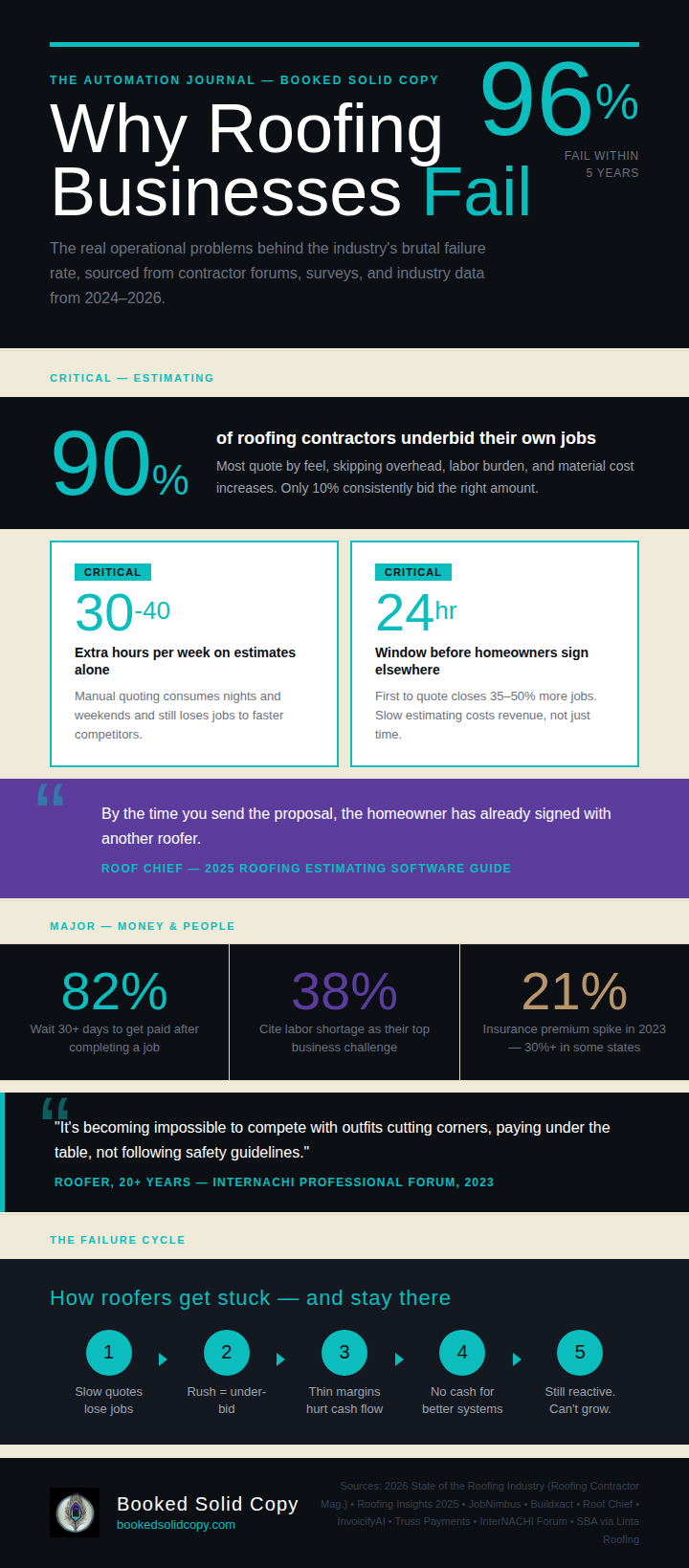
The roofing industry generates $15 billion a year in the United States. More than 79,000 roofing contractors are competing for that work. And yet, according to Small Business Administration data, 96% of roofing companies fail within their first five years.
That gap between a thriving market and a brutal failure rate is not an accident. It is the result of a set of recurring, solvable business problems that most roofing contractors never fully address. This post breaks down what roofing contractors are actually complaining about, sourced from industry surveys, trade forums, software company research, and real contractor voices.
If you run a roofing company or are thinking about starting one, this is worth reading carefully.
1. Estimating Eats Up the Hours They Don't Have
If you spend any time in roofing contractor communities, estimating comes up constantly. Not as a minor inconvenience. It is an operation-threatening drain on time that nobody has a clean solution for.
One contractor quoted in Buildxact's customer research put it plainly: he was spending 30 to 40 hours a week on estimates alone, on top of running an actual business.
JobNimbus, which works with thousands of roofing contractors, frames it this way: "Every roofing contractor knows the pressure: quotes that take too long, details that get missed, and competitors who undercut with sloppy proposals."
The problem compounds fast. Roof Chief's research found that homeowners expect quotes within 24 hours, and contractors who respond first close 35 to 50 percent more jobs than those who take longer. Meanwhile, the average roofing estimate done manually can take hours. For complex jobs, a single detailed bid can take the better part of a day.
One experienced contractor described the reality on Quora: a bid for a simple room addition without subcontractors took nine hours to write.
The result is a compounding problem. Slow quotes lose jobs. Manual calculations introduce errors. Errors cost money. And by the time the contractor catches a pricing mistake, they're already halfway through a job they're losing money on.
2. Nine Out of Ten Roofers Are Underbidding Their Own Work
This statistic appears in multiple independent sources: roughly 90% of roofing contractors underbid their jobs. Not by a small margin. Often by enough to eat their entire profit margin.
The core problem is how most roofers think about pricing. Many quote jobs based on a mental "per square" number that feels fair, without systematically accounting for overhead, labor burden, disposal costs, transportation, equipment wear, and the time they spend doing administrative work. When material costs rise (and they have risen substantially over the past several years), bids built on old assumptions become money-losers.
Construction Cost Accounting laid this out clearly in late 2025: "Many contractors underbid because they're using burden rates from 2-3 years ago. If your burden was 35% in 2023 and it's actually 45% now, you're losing 7-8% on every labor dollar."
The average roofing contractor operates on roughly 15% profit margins, according to SharpSheets data cited by FieldCamp. The target is 20 to 40%. The gap between where most contractors are and where they should be is almost entirely a pricing and estimating problem.
And yet as Jobber notes, "with a lot of competition in the roofing industry, as well as increased material and labor costs, many business owners end up underbidding to gain more work, sacrificing larger profits in the process."
It is a cycle. They underbid to win work. They win work at bad margins. They stay busy but stay broke.
3. Cash Flow Is the Hidden Crisis
The roofing business model is structurally backward for cash flow. A contractor buys materials, pays their crew, covers fuel and equipment, completes the work, and then waits to get paid. Sometimes for a long time.
According to data cited by Truss Payments, 82% of contractors wait more than 30 days for payment. Many wait 60. Some have to chase homeowners across multiple phone calls for months after a completed job.
InvoicifyAI captured the frustration in their 2026 contractor research: "You front the labor, you front the materials, you complete the job, and then you wait. Sometimes you have to chase the same homeowner across five phone calls to collect on a $15,000 job you finished two weeks ago."
The billing mistakes that make this worse are well-documented: no signed estimate before work starts, a single invoice at the end of a long project rather than milestone billing, vague payment terms, and no systematic follow-up process. None of these is complicated to fix. But most contractors are so consumed with the field work and the next job that the billing structure never gets the attention it deserves.
4. Labor Shortages Are Straining Every Crew
According to the 2026 State of the Roofing Industry report from Roofing Contractor magazine, the lack of qualified workers is the second-highest challenge for residential contractors, cited by 38% of respondents.
Fixr's 2025 roofing industry analysis put the scale of the problem in context: the construction industry needs an estimated 439,000 new workers in 2025 alone to meet demand.
What this means practically: roofing companies are competing for a shrinking pool of experienced workers. Those workers command higher wages. In hot markets with concentrated project activity, skilled labor commands 20 to 30% wage premiums above standard rates. Contractors who built their estimates on labor costs from two years ago are, again, losing money without knowing it.
The labor shortage also creates quality problems. When experienced workers are unavailable, contractors either slow down (losing revenue) or hire workers who are not fully trained (creating liability and rework costs).
5. Insurance Work Has Become a Different Job Entirely
For many roofing companies, storm damage and insurance work make up a significant portion of their revenue. And that work has gotten dramatically more complicated.
Roofing Insights' 2025 industry report describes the situation: "In 2023, property insurance skyrocketed 21%, and some states saw hikes of over 30%. It's also becoming harder to get claims approved. Insurance companies are cracking down on fraudulent claims, but this tighter scrutiny has left roofers dealing with more delays, denials, and slow payments."
AI-powered roof scans used by insurers are adding another layer of friction, particularly for hail damage claims. Contractors describe submitting supplements, waiting weeks for responses, disputing line items, and managing frustrated homeowners who blame the roofer when the insurer is slow.
In top storm markets like Florida, California, and Texas, major insurers have been pulling out entirely, leaving contractors to navigate increasingly complex claims environments with fewer options for their clients.
The administrative burden of insurance work is not included in most roofing estimates. It should be.
6. No Systems Means the Owner Is the Business
AccuLynx's analysis of why roofing companies fail identifies disorganization as one of the primary causes: "Roofing contractors that do not have an organized set of processes in place often struggle managing new leads, communicating with customers, and tracking projects throughout the pipeline."
The pattern is consistent: a skilled roofer starts a company because they are good at roofing. The business grows to a certain size. Then it hits a ceiling because everything runs through the owner's head. Leads are tracked in a notebook, or not at all. Follow-ups are done by memory. Project status lives in the owner's phone and nowhere else.
This creates a fragile operation where growth makes things worse rather than better. More jobs mean more chaos. More chaos means more mistakes. More mistakes mean more callbacks, disputes, and unhappy clients.
Roofing Contractor's 2026 survey found that 40% of roofing contractors are now using AI and automation in some form, up from 29% in 2024. The gap between contractors who systematize and those who do not is widening.
7. Competing Against Contractors Who Don't Play by the Rules
One of the rawest complaints from established roofing contractors is how hard it is to compete with operators who skip licensing, insurance, safety gear, and taxes.
A roofer with more than 20 years in the business described this on the InterNACHI professional forum: "It's becoming impossible to compete with all the outfits cutting corners, paying under the table to avoid taxes, not following safety guidelines. The sleazy companies slowly get weeded out, but there are always more to replace them."
When an unlicensed contractor can quote a job at $8,000 because they have no real overhead, an insured, licensed contractor quoting $12,000 for the same job faces an uphill battle explaining the price difference to a homeowner who does not know what they do not know. Roofing contractors consistently rank among the highest BBB complaint categories precisely because fly-by-night operators drag down the reputation of the whole industry.
What These Problems Have in Common
These are not independent issues. They are connected.
When estimating takes too long, contractors rush. When they rush, they underbid. When they underbid, they have thin margins. When margins are thin, cash flow is tight. When cash flow is tight, they can't invest in better systems or trained staff. When they don't have systems, they stay in reactive mode, unable to grow and unable to get ahead.
The contractors who break this cycle are the ones who treat the business side with the same seriousness they bring to the roof itself.
That means reliable, fast estimating that accounts for real costs. It means billing systems with clear terms, milestones, and follow-up. It means tracking leads and jobs through a structured pipeline rather than through memory. And it means pricing that reflects what the work actually costs, not what feels competitive in the moment.
The good news is that none of these problems requires complex solutions. They require the right tools, built to fit how roofing companies actually operate.
Booked Solid Copy builds custom estimation and automation tools for trade contractors, with one-time fixed pricing and no monthly fees. Learn more at bookedsolidcopy.com.
