

Spreadsheets vs. Estimating Software vs. Custom Tools: A Remodeler's Honest Comparison
If you are still building quotes the same way you were three years ago, you are probably leaving money on the table. Not because your prices are wrong, but because your process is.
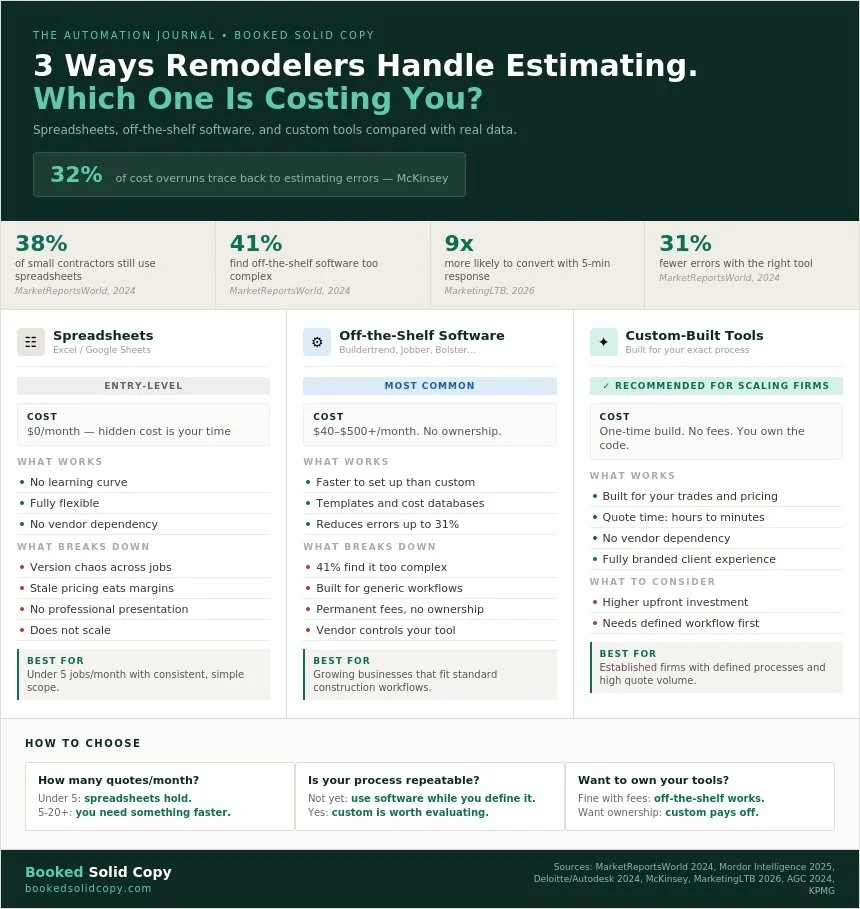
Most general contractors and remodelers fall into one of three camps when it comes to estimating: they are running spreadsheets held together by memory and formulas, paying a monthly subscription for software that covers 70% of what they need, or they have invested in a tool built specifically for how their business works. Each approach has a real cost and a real ceiling, and where you land matters more than most contractors realize.
This is not a pitch for any single product. It is a comparison of all three approaches, grounded in real data, so you can figure out which one actually fits where your business is right now.
Why Your Estimating Process Is a Business Decision, Not Just an Admin Task
Before comparing tools, it is worth getting clear on what is actually at stake.
Construction profit margins are thin. General contractors typically operate on net profit margins between 2% and 5%, according to industry analysis from Articulate. At those margins, a single bad estimate does not just cost you money on that job. It erodes your capacity to take the next one.
The numbers behind estimation failures are significant. According to research compiled by Contimod and McKinsey, 32% of construction cost overruns trace directly back to estimating errors. A KPMG study found that only 31% of projects came within 10% of their original budget. And in 2024, over 71% of construction firms reported significant errors in manual estimation, according to MarketReportsWorld.
Meanwhile, speed is becoming a competitive factor in ways it was not even five years ago. Research cited by Marketing LTB shows thatcontractors who respond to inquiries within five minutes are nine times more likely to convert than those who take longer. In a business where quoting a single job can take several hours, that creates a direct, measurable disadvantage against competitors who have faster systems.
So when you choose an estimating approach, you are not just choosing a tool. You are choosing your speed, your accuracy, your capacity, and ultimately, your ability to win jobs at margins that actually sustain the business.
Option 1: Spreadsheets
What They Are
Spreadsheets, primarily Microsoft Excel and Google Sheets, remain the default for a significant portion of contractors. According to MarketReportsWorld, 38% of small and regional contractors globally still rely on spreadsheets and manual calculations for estimating. They are free, familiar, and flexible, which makes them easy to keep using long after they have stopped serving the business well.
Where Spreadsheets Work
For contractors in the early stages of business, spreadsheets are a reasonable starting point. They require no learning curve beyond what most people already know, they can be customized however you want, and there is no subscription cost. If you are quoting a handful of similar jobs per month and your scope does not vary much, a well-built spreadsheet template can work fine.
Where Spreadsheets Break Down
The problems start showing up around volume and complexity. When you are juggling multiple quotes at once, spreadsheets become difficult to manage across versions. A formula gets broken in a copy. Material prices change, but the spreadsheet does not. A number gets transposed in a cell. Any one of these issues can quietly eat your margin on a job before you ever swing a hammer.
There are also presentation limitations. According to Buildxact, spreadsheet-based quotes often look inconsistent or incomplete to clients, which makes it harder to build trust or stand out against more professional-looking proposals.
The productivity cost is real, too. McKinsey research found that 35% of construction professionals' time is spent on non-productive activities. Manual data entry, reformatting, re-checking formulas, and rebuilding estimates from scratch every time a scope changes are exactly the kinds of tasks that fall into that category.
The ceiling: Spreadsheets are a starting point, not a scaling tool. Once your quote volume grows, your project complexity increases, or you start competing for higher-value work, spreadsheets will slow you down before you realize they have become the problem.
Option 2: Off-the-Shelf Estimating Software
What It Is
The construction estimating software market reached $2.73 billion in 2025 and is projected to grow to $5.01 billion by 2030 at a CAGR of 12.89%, according to Mordor Intelligence. The options are plentiful: Buildertrend, CoConstruct, Jobber, Houzz Pro, PlanSwift, Buildxact, and dozens of others. Most operate on a subscription model, with entry-level plans starting around $40 to $60 per month and more robust systems running into the hundreds.
These tools solve real problems. They typically include pre-built templates, cost databases, digital takeoff tools, client portals, and proposal generation. Some offer automated material pricing integrations and built-in job costing. When adopted successfully, the gains can be meaningful. Digital estimation tools can reduce average bid preparation time by 22% and help cut cost estimation errors by 31%, according to MarketReportsWorld.
Where Off-the-Shelf Software Works
Off-the-shelf software is well-suited for contractors who have outgrown spreadsheets and want a structured system they can get running quickly. The best platforms are designed around common residential construction workflows and come with templates and defaults that match standard scope categories. For contractors doing fairly predictable work within established project types, these tools can dramatically improve speed and consistency.
Where Off-the-Shelf Software Breaks Down
The adoption reality is harder than the sales page suggests. A 2024 AGC survey found that 47% of contractors cite getting employees to use new software as their single biggest technology challenge, ranking above cost, integration, and every other factor. According to MarketReportsWorld, 41% of contractors find off-the-shelf software platforms overly complex, which directly stalls adoption. Many platforms were built for larger enterprises and carry feature sets that small and mid-size remodeling firms will never use.
There is also the customization problem. Most off-the-shelf tools are designed around the most common workflows, which means they fit adequately for many contractors but precisely for very few. If your estimating process has specific trade breakdowns, a unique markup structure, subcontractor pricing logic, or client-facing tools that reflect how your business actually runs, you will spend a lot of time working around the software instead of working with it.
And then there are the fees. The subscription model that accounts for 63% of the estimating software market means your access is permanent only as long as your payments are. You do not own the tool. If the platform changes pricing, discontinues a feature, or gets acquired, your workflow depends on decisions made by someone else.
The ceiling: Off-the-shelf software is a meaningful upgrade from spreadsheets for many contractors. But for businesses with a defined process, a specific client experience, or growth ambitions that require precision at scale, the generic build will always leave gaps.
Option 3: Custom-Built Estimation Tools
What They Are
Custom estimation tools are software built specifically for one contractor's business: your trade categories, your pricing logic, your markup rules, your client interface. Instead of adapting your process to match a product, the product is built to match your process.
This category has historically been associated with large construction firms and enterprise-level budgets. That is changing. As development technology has become more accessible and specialized builders have entered the market, custom tools are now being built for small and mid-size remodeling and contracting businesses at price points that make sense for the ROI.
Where Custom Tools Work
Custom tools make the most sense when a contractor's estimating process is well-defined enough to systematize and complex enough that generic software cannot handle it cleanly. If you have specific trade scopes, layered pricing structures, regional labor rate considerations, or a client experience you want to own, a custom tool can do what no off-the-shelf product will.
The efficiency gains at this level can be significant. When a contractor's estimating workflow is fully systematized and automated, quote time can drop from several hours to minutes. That kind of compression changes how many leads you can quote, how quickly you can respond to inquiries, and how much of your week you spend building proposals versus building projects.
Speed matters here in a compounding way. The nine-times conversion advantage for contractors who respond within five minutes means that a faster quoting system is not just a time-saver. It is a revenue driver.
Custom tools also solve the ownership problem. You own the code. There are no monthly fees once the tool is built, no third party that can change the pricing structure or deprecates a feature you depend on, and no vendor relationship your business has to maintain. The tool is yours.
The Trade-Off
The upfront cost is higher than that of a subscription tool. Custom tools require an investment in the build itself, and they require that the business has a mature enough process to define clearly before the tool is built. If your estimating workflow is still evolving, custom may be premature. But for contractors who know how their business works and want a tool that works the same way, the long-term economics often favor custom significantly over years of SaaS subscriptions.
How to Decide Which One Is Right for You
The right tool depends on where your business is, not where you want it to be.
Stick with spreadsheets if: you are quoting fewer than five to ten jobs per month, your scope is highly consistent, and your business is still in the process of defining its estimating workflow. Investing in a more complex system before your process is settled will create overhead you do not need.
Look at off-the-shelf software if you have outgrown spreadsheets and need more structure, consistency, and professionalism in your proposals. You are comfortable with a monthly fee, your workflow fits reasonably well within standard construction categories, and you are willing to invest time in learning and adopting a new platform.
Consider a custom tool if: your estimating process is well-defined and repeatable, your job volume or growth goals make quoting speed a competitive factor, you want to fully own your workflow without vendor dependency, and you have specific client-facing or trade-specific needs that generic software has never solved cleanly.
The Bigger Picture
According to a 2024 report from Deloitte and Autodesk on digital adoption in construction, adding a new technology can boost revenue by 1.4% and profitability by 1% annually.For a contractor doing $2 million in annual work, that is $28,000 in additional revenue from a single upgrade to a better system.
The construction industry is in the middle of a significant digital shift. The estimating software market alone is on track to double in value by 2030. Contractors who adopt better tools earlier are not just getting more efficient; they are building a structural advantage over competitors who are still re-typing line items into spreadsheets every time a client calls.
The question is not whether your estimating process needs to evolve. The data is clear on that. The question is which direction evolution should go, and when.
Booked Solid Copy builds custom estimation and automation tools for trade contractors. If you are trying to figure out whether a custom solution is the right fit for your business, start by looking at how many hours per week your current process is costing you and what that time is actually worth. If you are trying to figure out whether a custom solution is the right fit for your business, schedule a 30-minute call, and we can walk through it
