

What Buildertrend, AccuLynx, and Knowify Get Wrong About Roofing Labor Costs
Most roofing contractors who figure out they have a labor margin problem do the same thing. They buy software.
The logic makes sense. The right platform will streamline estimates, track job costs, flag variances, and finally give you a clear picture of where the money is going. The monthly fee is worth it if it stops the bleeding.
Here is the problem. The software is not bleeding. Your formula is.
And no subscription platform on the market will fix that for you.
The Real Problem Is the Formula, Not the Filing System
The labor margin gap in roofing comes from one place. The estimate never included the full cost of the labor to begin with.
This is not a data entry issue. It is not a communication issue between the office and the field. It’s a calculation issue that happens before the first number ever touches a platform.
Setup. Material staging. Supplier runs. End-of-day cleanup. Safety walkthroughs. Pre-job crew briefings. All of it is on your clock. Almost none of it shows up as a line item in a typical roofing estimate.
The AGC's labor productivity research puts non-productive field time at 25-35% of total hours on residential construction jobs. For roofing specifically, the lower end of that range assumes a tight, experienced crew on a straightforward job. Complex roofs, new hires, unfamiliar sites, weather delays, each variable pushes that number higher.
Most estimates price installation hours. That is it. Everything else gets absorbed silently, job by job, month by month, until the bank account tells you something is wrong, and you have no idea why.
According to research on estimating accuracy, estimation errors cause a 30% decrease in win rates and approximately a 3% loss of profit on jobs you do win. But the labor billing gap is quieter than a lost bid. It never shows up as a missed close. It shows up as a margin that dissolves on every job you run, regardless of how well it goes.
Software records that loss accurately. It does not prevent it. See how labor rate miscalculation compounds across a full year here
How Much Is the Labor Billing Gap Actually Costing You?
The math on a 3-man roofing crew at a $48 loaded hourly rate looks like this.
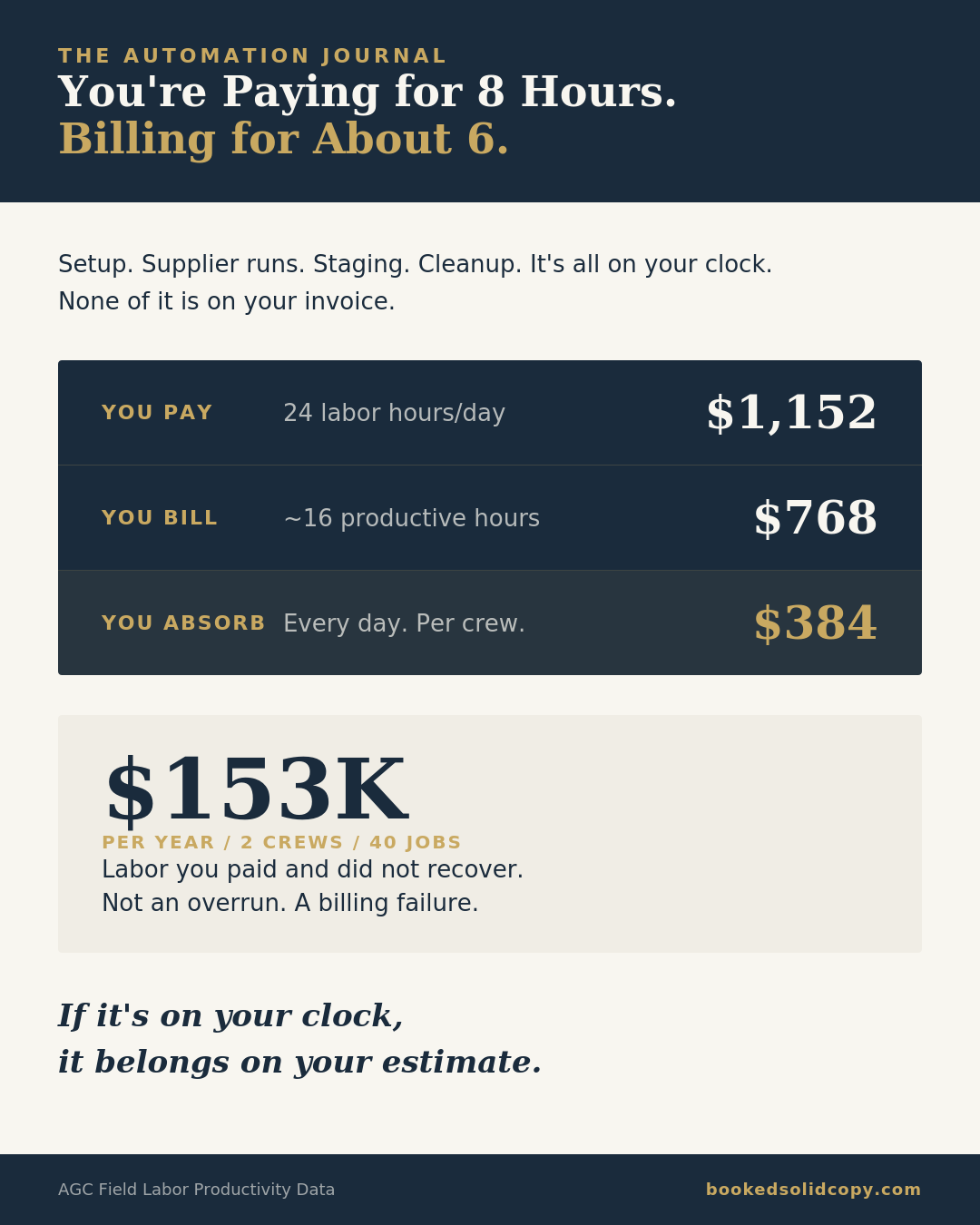
You pay 24 labor hours per day. That is $1,152 in daily payroll.
You bill roughly 16 productive install hours. That’s $768 recovered.
$384 absorbed per day, per crew.
On a 5-day job, that is $1,920 gone before the invoice is written.
Run two crews. Run 40 jobs a year
That is $153,600 in labor cost sitting between your payroll and your invoices.
That number has nothing to do with how well you managed the job. It has everything to do with what the estimate included.
The NRCA puts the average net margin for roofing contractors at 2.8%. On $1 million in revenue, that is $28,000. Before taxes. The labor billing gap alone can exceed that number on a two-crew operation.
Understanding exactly what your loaded labor rate should be, and why most roofing software never prompts you to calculate it correctly, starts with knowing the full cost of an hour of labor on your crew. See the full breakdown of the loaded labor rate calculation here.
What Buildertrend, AccuLynx, and Knowify Actually Do
None of these platforms is bad at what they do. The problem is that what they do is not what your labor margin problem needs.
Buildertrend
Buildertrend is a project management platform that happens to include an estimating module. It was built for home builders and remodelers first. Roofing contractors use it, but the product was not designed around how roofing jobs are priced, staffed, or won.
Pricing starts at $499 per month and runs to $899 or higher on upper tiers. Buildertrend's own positioning emphasizes scheduling, client communication, financial management, and project visibility. Those are workflow tools. They help you organize the information that already exists. They do not generate new information about what your labor actually costs.
The estimating module requires you to input your labor rates. The platform does not ask whether those rates are loaded, whether they include non-productive time, or whether they reflect your actual overhead allocation. You type a number. BuilderTrend uses it.
Users consistently report a steep learning curve and an interface that feels cluttered and overwhelming, particularly for contractors who do not need the full suite of project management tools and just need accurate estimates fast.
The data portability issue is worth understanding before you sign. Verified reviewers on Software Advice report that once information is inside the system, retrieving it later is a significant challenge. If you spend a year building out your pricing templates and then decide Buildertrend is not working, exporting that work is not a clean process.
You can also spend that entire year pricing labor the same wrong way you were before you signed up. The software will have tracked every job cleanly, reported your margin accurately, and never once flagged that the formula producing those numbers was off.
AccuLynx
AccuLynx is roofing-specific. That is genuinely a point in its favor. The platform is built for the roofing industry, integrates with aerial measurement tools like EagleView, and includes CRM, pipeline tracking, and material ordering in a single system.
Pricing starts around $60 per user per month. For a 10-person team, that is $600 a month before add-ons. For a larger crew, the per-user model scales up fast.
The estimating module is the part that matters for this conversation, and it is where the platform falls short of what contractors actually need. Contractors report that the estimating format is rigid, making it difficult to break out self-performed labor from subcontracted labor, add custom overhead allocations, or adjust the formula to reflect how a specific crew is actually deployed on a specific job type.
The inputs are yours to get right. AccuLynx does not validate whether your labor line reflects a fully loaded rate or just the wage you are paying at the end of each week. It does not prompt you to account for non-productive hours. If your formula has never included staging time, AccuLynx will not catch that. It will produce clean, professional estimates using your numbers and create the impression that your estimating process is dialed in.
The $600 to $1,000 a month you are paying for that impression is real money. Overhead miscalculation in your estimates compounds that cost on every job you run.
Knowify
Knowify targets trade contractors across multiple disciplines and runs $99 to $249 per month, depending on the tier. It handles job costing, time tracking, scheduling, and contract management. For service work and smaller operations, contractors report that it handles day-to-day scheduling well.
For estimating, Knowify provides templates. You configure them. The platform has no mechanism for evaluating whether the labor inputs you put into those templates reflect a loaded rate. It tracks labor hours, reports on variances between estimated and actual costs, and sends you that data in a clean dashboard.
What that means in practice: if your template has always used a $35 wage rate instead of a $48 loaded rate, Knowify will report variance between your $35 estimate and the $48 actual cost on every job, every month, and it will continue to do so until you change the template. The platform is doing exactly what it was designed to do. The problem is that the problem lives upstream of where the software operates.
The 12-Month Cost of Using the Wrong Tool
What does a year of wrong-formula estimating look like on a platform like any of the three above?
Month 1: You sign up, pay onboarding fees, and spend 3 to 4 weeks getting your templates configured. You are still using your existing labor rates because the platform did not prompt you to recalculate them.
Months 2 through 6: Jobs are running. Estimates are going out faster. The platform is tracking everything. Margin looks about the same as it did before, which you attribute to a slow season or rising material costs.
Months 7 through 12: You start pulling reports. The platform tells you your labor variance is consistently negative. You assumed that was the software showing you a problem; it was also helping you fix. It was just showing you the problem.
End of year 1: You have paid $6,000 to $11,000 in subscription fees, configured an estimating template around an incorrect formula, and produced a year of accurate records showing you lost labor margin on every job.
The formula never changed. The platform just made it easier to see how consistently it was failing.
What Roofing Estimating Software Actually Needs to Do to Protect Labor Margin
The software question matters less than the formula question. But for contractors who want both answered at the same time, here is what a real solution looks like.
Every estimate starts from a loaded labor rate that includes total crew cost per hour, not wage cost. That means the base wage, payroll taxes, workers' compensation at the roofing class code rate (which the NRCA notes averages 33% of payroll nationally for roofing), benefits, and any other direct cost tied to the employee being on that job.
Non-productive time is built into the formula. Not estimated. Not added as a contingency. Calculated based on your actual crew and your actual job types, then locked into the system so every estimate reflects it automatically.
Overhead is calculated as a percentage of revenue, not added as a flat dollar amount after the fact. The difference between those two approaches is significant on every job.
Margin is calculated on the selling price, not the cost. Cost times 1.20 is a 16.7% margin. Cost divided by 0.80 is a 20% margin. That difference is $500 on a $10,000 job. Across a full year, it is the spread between the NRCA's 2.8% average and what a top-quartile roofing company actually nets.
When those inputs are encoded in the tool rather than left to an estimator's memory or a salesperson's judgment, the formula does not degrade under pressure. It does not get rounded down on-site to close a deal. It does not vary based on who built the estimate that day.
See what a custom-built estimation tool does differently for roofing contractors.
Frequently Asked Questions
Does BuilderTrend include a loaded labor rate calculator for roofing contractors?
No. BuilderTrend's estimating module requires you to input your own labor rates. The platform does not prompt you to calculate a loaded rate, does not account for non-productive field time, and does not validate whether your inputs reflect your actual cost of labor. It uses whatever number you provide.
Can AccuLynx calculate non-productive labor time in a roofing estimate?
AccuLynx does not automatically account for non-productive labor time. The platform's estimating format is designed around material and labor line items that you configure. Contractors report difficulty customizing the labor breakdown to separate self-performed labor from subcontracted labor or to add overhead allocations at the estimate level.
What is the difference between a loaded labor rate and a wage rate in roofing?
A wage rate is what you pay an employee per hour. A loaded labor rate is the true cost of that employee per hour, including payroll taxes, workers' compensation insurance, general liability insurance allocation, benefits, and any employer costs tied to that labor. For roofing, the gap between wage rate and loaded rate is typically 30 to 50%, depending on the state, the class code, and the company's benefit structure. Estimating from the wage rate and billing as if it were a loaded rate means absorbing that gap on every job.
Is there roofing estimating software with no monthly fee?
Most of the major platforms, including Buildertrend, AccuLynx, and Knowify, operate on monthly subscription models. A custom-built estimation tool is a one-time fixed-price investment. You own the code, pay no monthly fee, and the formula is built around your actual cost structure rather than a generic template. Booked Solid Copy builds custom estimation tools for roofing contractors on exactly this model.
Why do roofing contractors lose money even when they use estimating software?
Because the software does not fix the formula. It organizes and tracks whatever numbers you put in. If the labor rate was wrong before you bought the software, it will remain wrong after. The platform will simply report the loss more clearly. Fixing the margin problem requires correcting the formula first, then encoding it in a system that applies it consistently to every estimate.
What should roofing estimating software actually include to protect labor margin?
At minimum: a loaded labor rate that accounts for all employer costs, a non-productive time factor built into the formula, overhead calculated as a percentage of revenue, and margin calculated on the selling price. Most subscription platforms leave all of these inputs to the user. A custom tool built around your specific operation encodes them from the start.
The Bottom Line
BuilderTrend, AccuLynx, and Knowify are real tools with real users. For contractors who need scheduling, pipeline management, client communication, and document storage in one place, they solve genuine problems.
They do not solve the labor margin problem. That problem lives in the formula, and the formula is set before any of these platforms ever open.
The contractors who stop bleeding labor margin on every job are not using better software. They are using a system where the right formula was encoded before the first estimate went out, and where no one can override it without changing the system.
