

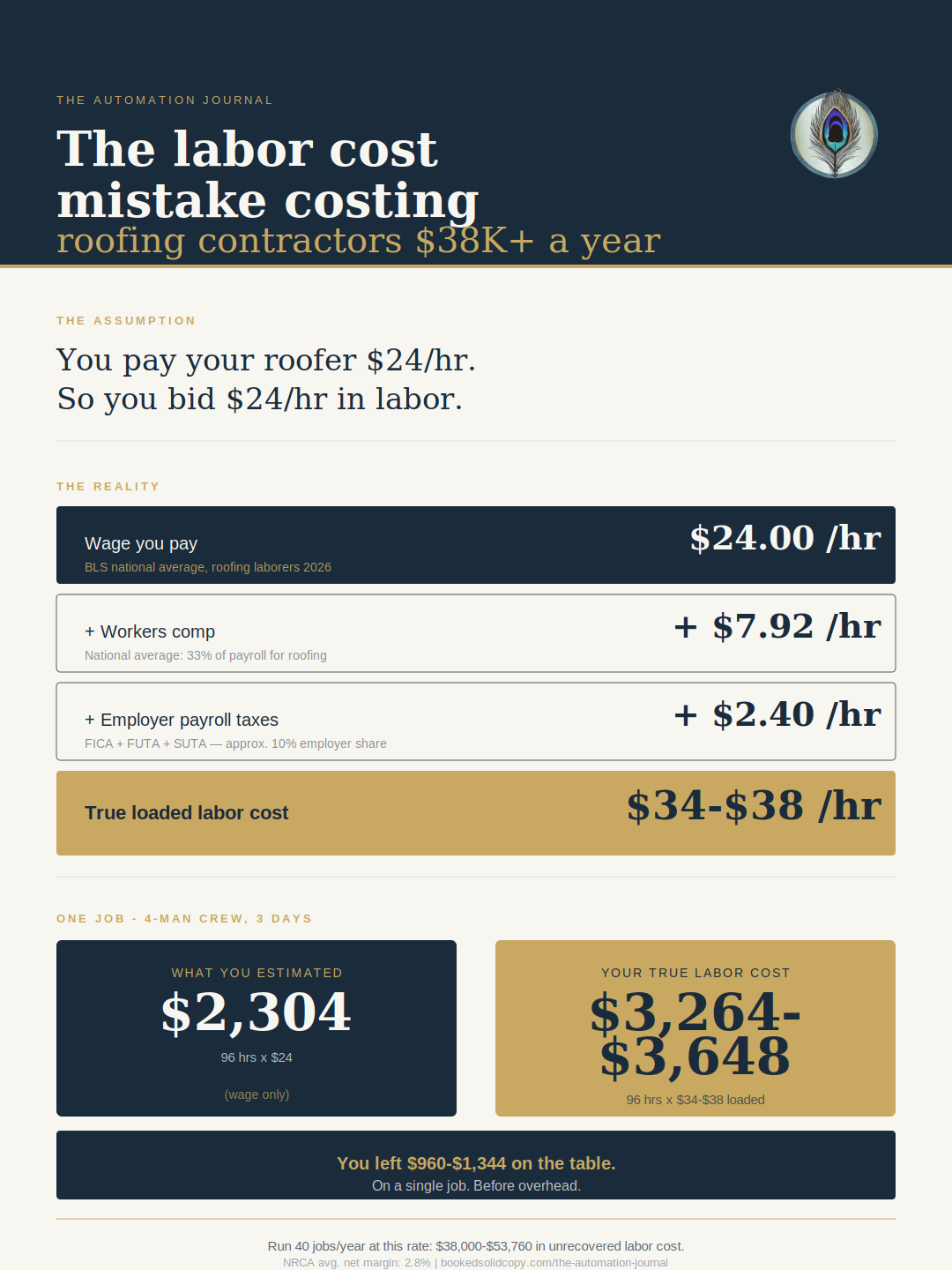
Most roofing contractors are bidding jobs using a number that does not exist.
Not the number on their invoice. Not the number their accountant uses. The number they write into the estimates: the wage they pay their roofer per hour.
That number is not what a roofer costs. It is what a roofer earns. There is a significant difference, and every job bid on the lower number is a job with a margin problem baked in before the first shingle goes up.
The NRCA reports the average net profit margin for roofing contractors at 2.8%. Half of all roofing companies make less than that. Labor miscalculation is one of the core reasons why.
This post walks through exactly how to calculate your loaded labor rate, what most contractors miss, and what the number looks like on a real job.
What Is a Loaded Labor Rate?
A loaded labor rate (also called a fully burdened labor rate) is the true hourly cost of putting a worker on a job site. It includes the wage you pay plus every mandatory cost attached to that wage.
The unloaded rate is what the worker earns. The loaded rate is what the worker costs you.
According to SmartBarrel's construction labor burden analysis, roofing contractors carry some of the highest labor burden rates in the construction industry, ranging from 50% to 70% above base wages due to workers compensation requirements for fall-risk work.
That means a roofer earning $24 per hour does not cost $24 per hour. He costs $36 to $41 per hour once every mandatory cost is factored in.
What Goes Into a Loaded Labor Rate
There are four categories of cost every roofing contractor needs to account for.
1. Base Wage
This is the starting point. The Bureau of Labor Statistics reports the average hourly wage for roofing laborers at $24 nationally in 2026, with variation by state and market.
This is the number most contractors use in their estimates. It is also where the problem starts.
2. Workers Compensation Insurance
Workers’ comp is the largest single add-on for roofing contractors.
According to Contractors Liability, the national average workers’ comp rate for roofing is 33% of payroll before taxes. Some states run higher. New York's residential roofing rate was $15.27 per $100 of payroll as of 2026, according to Enforce Coverage Group's 2026 rate guide.
On a $24 per hour wage, workers’ comp adds $7.92 per hour.
Roofing carries one of the highest workers’ comp classifications in the trades because falls are the leading cause of construction fatalities. The risk is priced accordingly by insurers, and that price lands on every estimate you write.
3. Employer Payroll Taxes
These are mandatory and non-negotiable. Every employer pays them.
FICA (Social Security and Medicare): 7.65% of wages up to the applicable wage base.
FUTA (Federal Unemployment): 0.6% on the first $7,000 per employee after the standard credit.
SUTA (State Unemployment): Varies by state and claims history, typically 1% to 6% of wages.
Combined employer payroll taxes average approximately 10% of wages for most roofing companies. On a $24 per hour wage, that adds $2.40 per hour.
4. Non-Productive Time
This is the one most contractors forget entirely.
Your roofer does not bill 40 hours of productive work every week. He gets paid for the drive to the job site. He gets paid when it rains and the crew sits. He gets paid for the 15 minutes of setup before the first nail goes in and the 20 minutes of cleanup after the last one.
According to a 2023 NRCA study cited by RoofPredict, 68% of mid-sized contractors fail to track indirect labor costs like crew travel time and job walk-throughs, which can consume 12% of a project's labor budget.
A typical roofing crew works roughly 45 productive weeks per year when you account for holidays, weather days, equipment issues, and job transitions. If you pay for 52 weeks and only bill for 45, that gap is 13.5% of your annual labor cost that disappears before a quote is written.
The Loaded Labor Rate Calculation
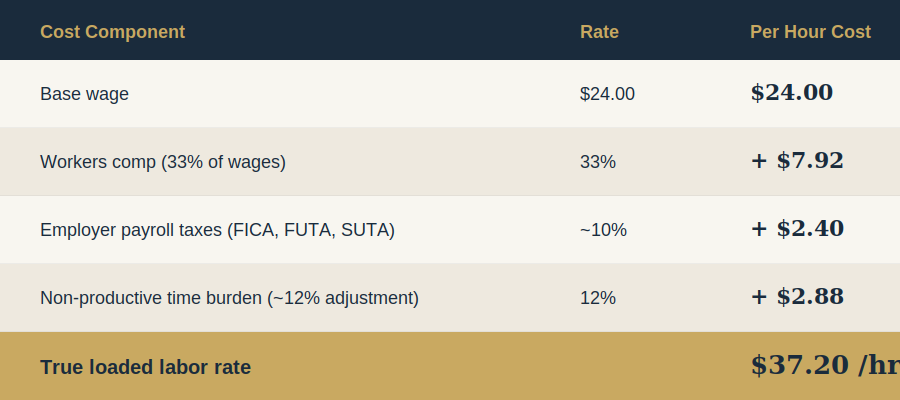
Here is the full formula applied to a $24 per hour roofer.
If you are bidding labor at $24, you are recovering $24 of every $37.20 in actual labor cost. The remaining $13.20 per hour per worker comes out of somewhere. In most cases, it comes out of the margin.
What This Looks Like on a Real Job
A 4-man crew working a 3-day job logs 96 man-hours.
Bid using the unloaded rate ($24/hr): 96 hours x $24 = $2,304 in estimated labor cost
Actual cost using the loaded rate ($37.20/hr): 96 hours x $37.20 = $3,571 in true labor cost
The gap is $1,267 on one job.
The NRCA puts the average net margin at 2.8%. On a $12,000 job, that is $336 in net profit. A $1,267 labor undercount erases that margin and sends you into the red before overhead is even counted.
Run 40 jobs a year with this gap. That is $50,680 in unrecovered labor cost annually, operating at scale, on a formula error.
Why Most Contractors Get This Wrong
The most common version of this mistake is not a calculation error. It is that contractors were never taught to separate the wage from the cost.
When you hire someone and agree to pay them $24 an hour, $24 is the number in your head. It goes into the estimate. It feels right because it matches the check you write.
What does not feel as tangible is the workers’ comp invoice that arrives quarterly. Or the payroll tax deposit that goes out twice a month. Or the foreman standing around for 45 minutes while a material delivery is sorted out. Those costs do not feel like labor because they do not show up on the job site as a number. They show up months later on a P&L that does not match what you expected.
Projul's construction labor burden guide identifies one of the most expensive versions of this problem: using a blended rate across all trade classifications. A cleanup laborer and a roofer carry completely different workers’ comp rates. Using one number for both means you are underpricing your highest-risk work and overpricing your lowest-risk work. The competitive market prices you out of the profitable jobs and into the ones that cost you money.
How to Set Your Loaded Labor Rate
Step one: Pull your actual workers’ comp rate from your policy documents. Do not use an industry average. Your rate reflects your claims history, your classification code, and your state.
Step two: Calculate your employer payroll tax burden. Your payroll provider or accountant can give you the exact number. For most roofing companies, it ranges from 9% to 12% of wages.
Step three: Track your actual productive hours versus paid hours for 4 to 6 weeks. Divide the total labor cost by the total productive hours billed to jobs. The ratio tells you your true efficiency factor.
Step four: Build a separate loaded rate for each crew classification. Your foreman's rate is different from your laborer's rate because their comp classification is different.
Step five: Use that loaded rate in every estimate, every change order, and every internal job cost report. Not the wage. The loaded rate.
The Connection to Your Estimation System
Most contractors do not have this calculation automated. They rely on memory, habit, or a spreadsheet that does not update when comp rates change.
The result is a business that bids jobs accurately in June and quietly loses money by November because labor costs have shifted and the estimate formula has not.
A custom estimation tool encodes your loaded labor rate into every quote automatically. When your workers’ comp rate changes at renewal, you update one number, and every future bid reflects it. There is no manual calculation, no approximation, and no $1,267 gap on a 3-day job.
If you want to see what your current labor rate should actually be and how much margin that difference represents on your job volume, message me directly. I build these tools for roofing contractors, and the first conversation costs nothing.
Key Takeaways
The wage you pay is not the cost you carry. For roofing contractors, the true loaded labor rate runs 50% to 70% higher than the base wage when workers’ comp, payroll taxes, and non-productive time are properly accounted for.
Every estimate written on the unloaded rate has a margin problem before the job starts. The NRCA's 2.8% average net margin is not an accident. It is the predictable output of a widespread calculation error compounded across the industry.
Fix the number you put into estimates, and the margin starts to move.
Courtney Combs is the founder of Booked Solid Copy, a Lexington, Kentucky-based business that builds custom estimation software for trade contractors. Her tools reduce quote time by up to 99% and encode accurate labor burden, overhead, and margin calculations into every bid.
Read more at The Automation Journal.
