

The Roofing Contractor's Cash Flow Calendar: Why Most Companies Run Out of Money in November
The roofing company had $300,000 in the bank in September.
By November, it could not make payroll.
Revenue was strong. The backlog looked solid. The owner had worked harder that year than in any year before. And still, in the fourth quarter, the business was borrowing to cover overhead it had already committed to in August.
This is not a story about a bad year. It is a story about a predictable problem that most roofing contractors do not see coming until they are already in it.
According to Estmere, a financial services firm specializing in construction and roofing, cash flow problems rarely come from low sales. They come from low visibility. When owners make decisions based on what the bank account shows today, they miss what that money already belongs to.
This post maps the cash flow calendar for a roofing business, month by month, and shows exactly where the structural problems live.
Why Roofing Has a Cash Flow Problem Other Trades Do Not
Most construction trades follow revenue throughout the year. Plumbers get called for emergencies in January. HVAC companies are busy in summer and winter. Roofing does not work that way.
According to Bureau of Labor Statistics data cited by Nickel's roofing cash flow guide, construction employment hits its lowest point in February, approximately 10% below the annual average, and peaks in August at 7% above average. For roofing specifically, the swing is sharper.
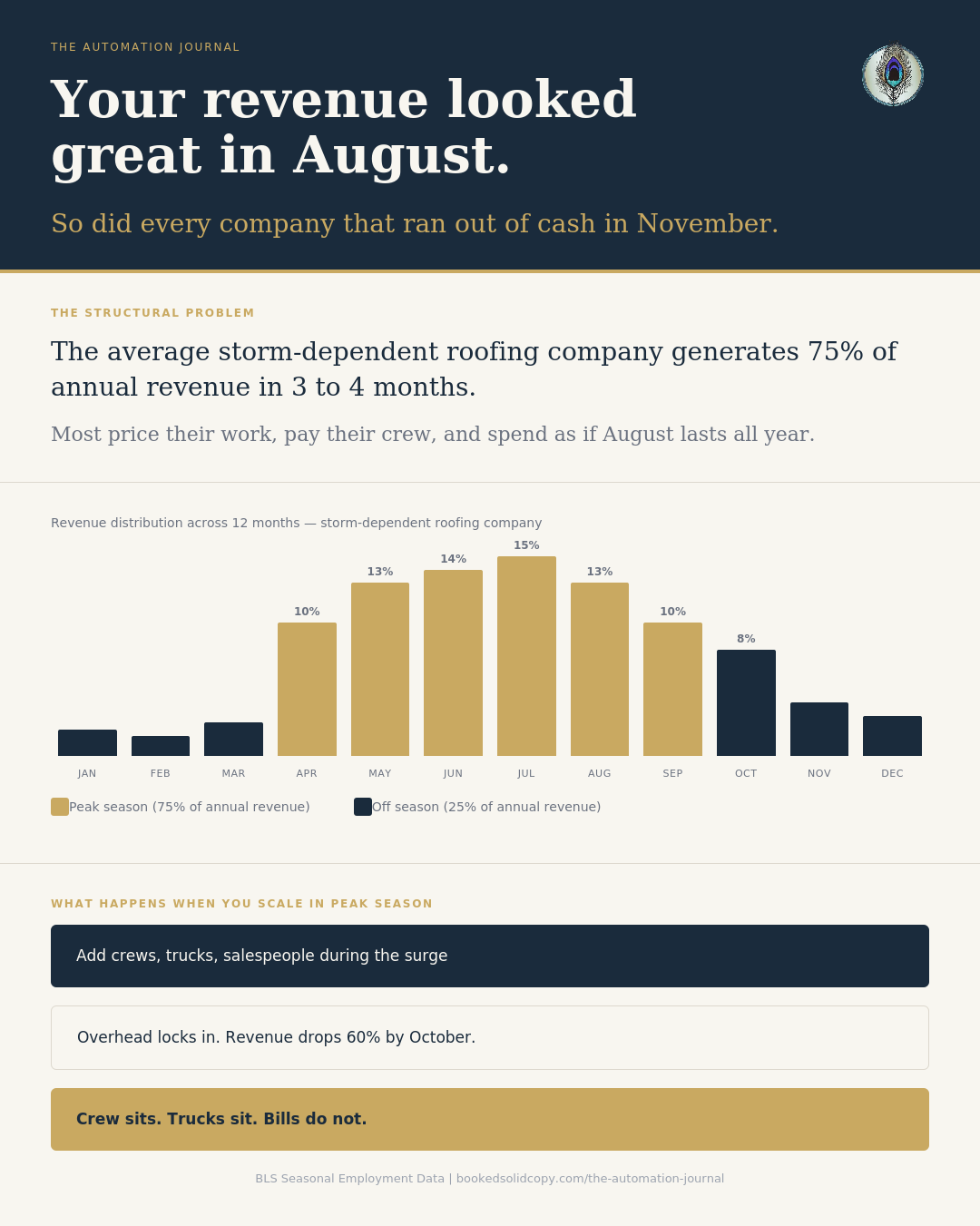
Storm-dependent roofing companies generate an estimated 75% of annual revenue in 3 to 4 months. For a company doing $2 million in annual revenue, that means $1.5 million arrives between May and August. The other $500,000 has to cover everything from September to April.
That is not a cash flow problem. That is a math problem. And it has a different solution.
The 12-Month Cash Flow Calendar
January and February: The Bottom
January is the hardest month for roofing cash. New jobs are thin. December's invoices are still being collected. The crew is on reduced hours or laid off. But the fixed overhead, insurance, truck payments, rent, and the owner's draw did not take December and January off.
The average construction company net profit margin is 6.3%, with best-in-class firms reaching only 11.9%, according to industry financial data. When you operate on margins that thin, a two-month revenue trough is not a temporary inconvenience. It is a structural threat.
What well-run companies do in January: They are not scrambling. They built a cash reserve during peak season specifically to cover this period. The target is two to three months of operating expenses in reserve entering the slow season.
Most companies do not hit that target.
March: The False Start
March brings warmer weather in most markets, and with it, the temptation to ramp back up. Hiring picks back up. Marketing spend increases. Owners start feeling optimistic.
The problem is that March revenue does not collect until April or May. A roofing company that bills $80,000 in March work may not see that cash until the middle of May, sixty days later, while the overhead from ramping up in March is due now.
Construction businesses suffer from extreme payment delays. The average days’ sales outstanding (DSO) for the construction industry sits at 94 days. That means you are waiting three months to collect on work you have already paid your crew to complete.
April Through June: Building Momentum
This is where roofing companies start generating real revenue. Leads pick up. The phone is ringing. Estimates are going out.
It is also where the most dangerous decisions get made.
A contractor who felt the January and February pain started spending aggressively to build the business he needed during the slow season. New truck. Additional crew. A salesperson. Maybe a second crew lead.
Each of those decisions increases fixed overhead permanently. The truck payment does not stop in October. The crew lead's salary does not disappear when the backlog clears. The salesperson still needs to be paid in November even if they are not generating leads.
July and August: Peak Season
This is when the cash feels abundant. Jobs are stacking up. Deposits are coming in. Revenue is strong.
Storm season makes any roofing company feel cash-rich. Many owners expand aggressively, adding crews, trucks, and salespeople, only to face a painful slowdown 90 days later. Roofing companies often hit cash crises not due to profitability issues but because they scaled based on temporary revenue spikes.
The trap is invisible in July because July looks like proof that the business is working. The company does not realize it overspent until November, when the revenue that funded August is gone, but the overhead August created is still running.
September and October: The Shoulder Season
This is the warning period. Revenue starts thinning. The backlog that looked full in August is clearing faster than new jobs are coming in.
What companies should do in September: Accelerate invoicing on all open jobs. Start cutting discretionary expenses. Collect aggressively on aging receivables. Enter winter with as much cash as possible.
According to Nickel's roofing cash flow guide, the single most effective cash flow strategy is building and tracking a seasonal forecast. Track weekly: current cash position, accounts receivable aging, upcoming payables, and variance from forecast. That 15 minutes on Friday is worth more than any marketing tactic in October.
What most companies do in September: Keep spending at the August rate because revenue is still coming in, and it does not feel like fall yet.
November and December: The Reckoning
This is where the $300,000 becomes a payroll problem.
The cash that was in the bank in September was not all yours. One $3.5 million roofing company found that $300,000 sitting in their account in November actually belonged to subs and suppliers. Once they implemented roofing-specific forecasting, they could see the real cash position clearly for the first time.
Revenue drops 60% to 80% for storm-dependent roofing companies between peak and off-season. Overhead does not drop with it. The fixed costs committed in June, July, and August are still running in November at full speed.
Companies that survive this period do two things differently. They build the reserve in peak season intentionally. And they know their numbers before the trough arrives, not after.
The Three Decisions That Create November Cash Crises
Decision 1: Scaling overhead in peak season without a 12-month model.
Every new hire, vehicle, and lease committed in the summer needs to generate enough revenue to cover its cost through winter. Most contractors do not run that math. They see revenue, and they spend.
Decision 2: Not separating operating cash from reserve cash.
A bank account with $300,000 in September looks like $300,000 available. But if $180,000 of that is owed to suppliers, $60,000 is earmarked for payroll due in two weeks, and $40,000 represents deposits on jobs not yet completed, the actual available cash is $20,000. Most contractors do not have a system that shows them the real number.
Decision 3: Pricing as if every month is August.
Your overhead rate changes across the year. Running a crew of twelve in August makes sense when you have 30 jobs queued. Running a crew of twelve in December when you have four jobs creates a cost-per-job overhead problem that your pricing never accounted for.
The contractors who run 12-month models price each job to carry its share of the full-year overhead, not just the overhead from the month it was sold.
What the Well-Run Roofing Company Does Differently
The companies that do not run out of cash in November share a few common practices.
They build a cash reserve target during peak season. The goal is to have two to three months of operating expenses in a separate account before October first.
They track a 13-week rolling cash flow forecast. Every week, they know what is coming in, what is going out, and what the balance will be 90 days from now. This is the difference between reacting to a cash crisis and preventing one.
They separate peak-season decisions from peak-season revenue. Before adding a truck or a crew in July, they model what that commitment costs in January. If the January math does not work, the July decision does not get made.
They invoice immediately upon milestone completion. Getting invoices out the same day work is completed reduces payment delays significantly. On a $2 million operation, moving from a 45-day average collection to 30 days frees roughly $83,000 in working capital.
The Estimation Connection
Most of the cash flow problems described above have a root in the estimation process.
When jobs take three hours to quote, the response time problem described in The Automation Journal's post on lead response rates compounds into a pipeline problem. Slow quotes mean slow job starts. Slow job starts mean uneven revenue timing. Uneven revenue timing means cash flow volatility.
When estimates do not correctly account for loaded labor rates and overhead, jobs run with a margin too thin to build a reserve. There is no surplus in August because the margin was wrong in May.
A custom estimation tool built around your actual numbers, with correct labor burden, overhead allocation, and margin targets, does not just save quoting time. It creates the financial discipline that makes a cash reserve possible.
If your estimating process is eating hours every week and your margins are not building the reserves you need, that is a system problem with a specific fix. Message me directly, and I will show you how the companies I work with handle both.
What to Do This Week
Build a simple version of your cash flow calendar. Take the last 12 months of bank statements and map your revenue by month. Then map your fixed costs by month. The gap between them in the slow months is the number you need to have in reserve before October.
If that number is not currently sitting in a separate account, you know the target for next peak season.
The goal is never to be surprised by November again.
Courtney Combs is the founder of Booked Solid Copy, a Lexington, Kentucky-based business that builds custom estimation software for trade contractors. Her tools reduce quote time by up to 99% and are built around the actual numbers that determine whether a roofing company is profitable.
Read more at The Automation Journal.
