

Why Commercial Contractors at $3M–8M Revenue Outgrow Every Estimating Software They Try
You bought the software. You paid for the onboarding. You sat through the demos. And your estimators are still quoting different numbers on the same job.
That is not a training problem. That is a fit problem.
Off-the-shelf estimating platforms are built to serve as many contractors as possible. That means residential builders, specialty trades, mega-project GCs, and everyone in between. A $5M commercial contractor with multiple divisions, multiple states, and multiple project types fits none of those categories cleanly.
The result is software that forces your business to conform to its logic instead of the other way around. And that costs real money.
The Estimating Problem Is Bigger Than You Think
Estimating errors are not occasional. They are structural.
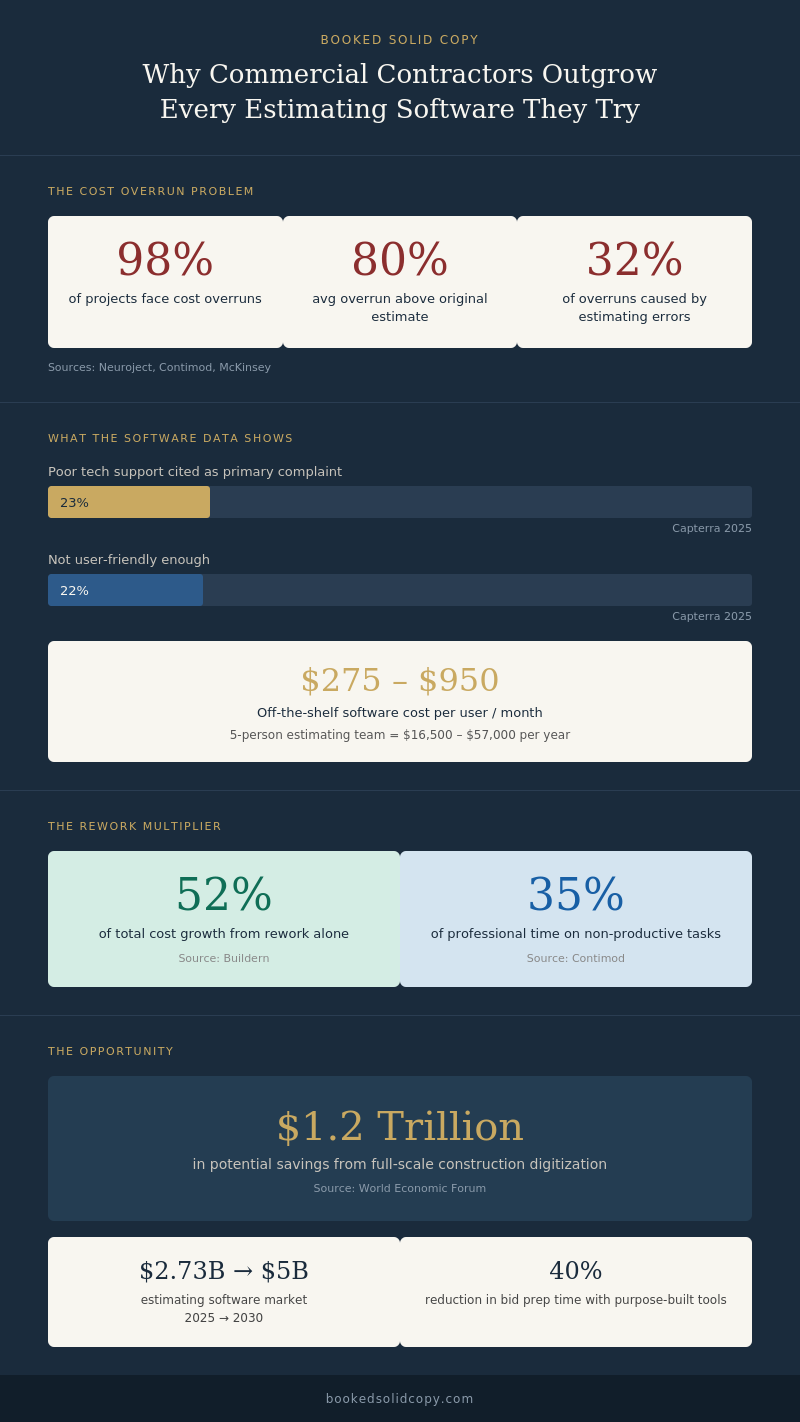
32% of all construction cost overruns trace directly to estimating errors. Not weather delays. Not scope creep. Estimating errors. And
98% of construction projects globally experience cost overruns or delays, with the average overrun sitting at 80% above the original estimate.
That unpredictable material swings or bad subcontractors do not drive 80% figure.
A 2024 analysis of 405 scholarly studies ranked project estimation inaccuracy as the single most influential factor in cost overruns, with a network centrality score of 0.922 out of 1. It is the root problem that makes every other problem worse.
For a commercial contractor running $5M in annual revenue, an 80% cost overrun on even one mid-size project can erase margins for the entire year.
Why Off-the-Shelf Software Makes This Worse
Procore, Buildertrend, and BuildXact are not bad software. They are the wrong software for a mid-size commercial contractor with specific workflows and multiple divisions.
Here is what the user data actually shows:
Capterra's 2025 Tech Trends Survey of 3,500 software buyers found that 23% cited poor technical support as their primary dissatisfaction driver. Another 22% said their solution was not user-friendly enough. Steep learning curves and limited customization were the two most cited complaints across the board.
Buildertrend is documented as primarily designed for residential contractors. Commercial GCs using it consistently note that the accounting side doesn’t work for their project type. That is not a user error. That is a product scope problem.
Procore is enterprise-grade software priced to match.
Off-the-shelf estimating software ranges from $275 to $950 per user per month. For a commercial contractor with a five-person estimating team, that is $16,500 to $57,000 per year, for software that was not built for your business.
The deeper issue is data silos. Contractors running commercial projects at this revenue level are managing separate estimating, scheduling, field reporting, and financial tools that cannot share data seamlessly. The re-entry work that creates eliminates any efficiency the software was supposed to deliver.
Interoperability gaps with legacy tools remain the primary barrier to software adoption across the industry, according to market research published in 2025.
The Real Cost of Inconsistent Estimates
Walk through what inconsistent estimating actually costs at the business level.
Two estimators quote the same commercial renovation. One comes in at $280,000. The other comes in at $340,000. The $280,000 quote wins the bid. The project costs $340,000 to deliver. That is not a one-time mistake. That is a broken process that repeats on every job where pricing logic lives in someone’s head instead of a system.
Rework alone contributes to 52% of total cost growth in construction projects and accounts for up to 22% of schedule overruns. Most rework starts with estimating errors that go uncorrected in the bid.
35% of construction professionals' time is spent on non-productive activities. For a commercial contractor, a significant share of that is manual data entry, spreadsheet reconciliation, and re-keying numbers between systems that don’t talk to each other.
Every hour spent correcting estimates, re-entering data, or chasing down why one rep quoted differently than another is an hour not spent on the next bid.
The Software Market Is Not Built for Your Revenue Band
The construction estimating software market hit $2.73 billion in 2025 and is projected to reach $5 billion by 2030. That growth is being driven by enterprise-level platforms targeting mega-projects and large GCs.
The $3M–$8M commercial contractor is an afterthought in that market. Too complex for the small-business tools. Not large enough to justify enterprise licensing. Pushed toward platforms designed for residential builders or platforms priced for firms ten times their size.
The 60% of contractors who cite fast cost calculation as their single most requested feature are not asking for more features. They are asking for something that works correctly for how they actually do business.
What Actually Fixes the Problem
The fix is not a different off-the-shelf platform. It is software built around the specific pricing logic, workflow, and division structure of one business.
That means:
Pricing logic that matches how you actually estimate. Not a generic materials database. Your labor rates, your material markups, your regional variables, and your subcontractor relationships are built into the calculation, so every estimator produces the same number on the same job.
Workflows that match your division structure. A commercial GC running concrete, interiors, and general contracting has different estimating requirements for each division. Custom software accounts for that without requiring a workaround or a separate platform for each trade.
No retraining every time a new estimator joins. When pricing logic is embedded in the tool, a new hire with basic digital literacy produces an accurate quote in their first week. No tribal knowledge required.
According to the World Economic Forum, full-scale digitization could save $1.2 trillion across design and construction globally. That opportunity does not come from buying another subscription. It comes from building systems that actually match how a specific business operates.
The Bottom Line
Generic software is built for the average contractor. There is no average contractor.
A commercial GC at $5M in revenue has a specific way of measuring, pricing, and delivering work. That methodology did not develop by accident. It developed through years of jobs, mistakes, refinements, and hard-won knowledge about what margins need to look like to keep the business healthy.
Software that ignores that methodology and forces estimators to work around it does not just create inefficiency. It creates inconsistency. And inconsistency at the estimating stage compounds through every phase of the project.
Fewer accurate bids mean fewer jobs won at the right margins. Fewer jobs at the right margins means less work for crews, fewer subcontractor relationships, and fewer opportunities across the board.
The contractors who are growing at this revenue level are not using better generic software. They are using systems built specifically for how they work.
Courtney Combs builds custom estimation tools and business automation systems for commercial contractors. No monthly fees. You own the code. Learn more at bookedsolidcopy.com or book a free 30-minute call to talk through whether a custom tool makes sense for your operation.
