

Why Contractors Don't Get Paid for Half the Work They Do
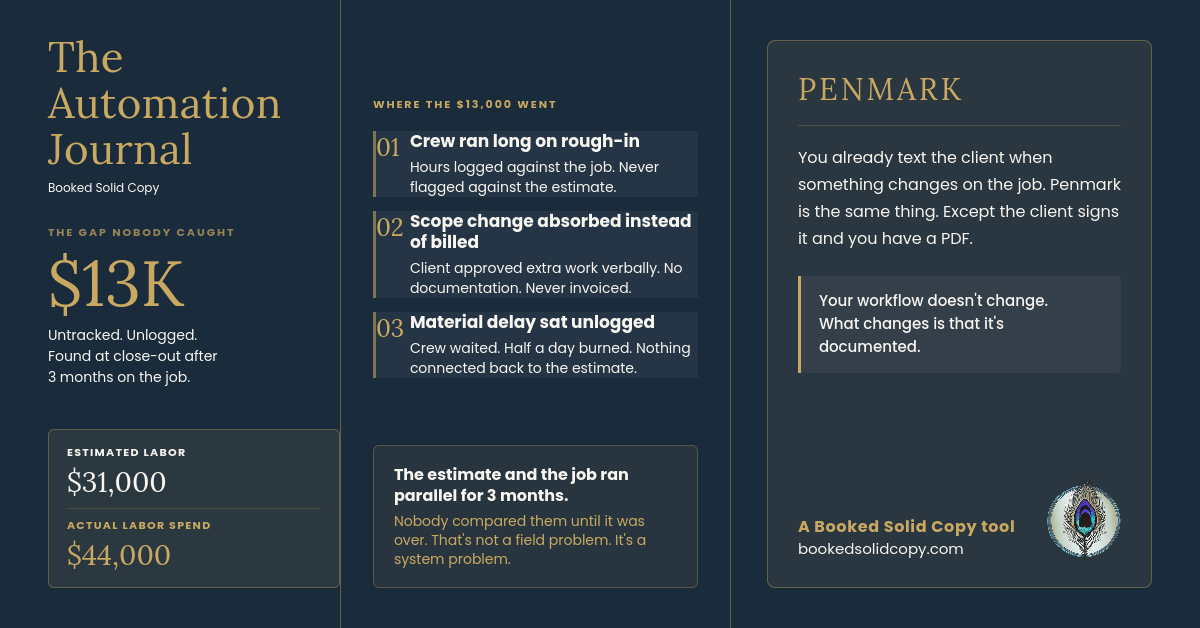
You did the work. You sent a crew. You bought the materials. You solved a problem the original contract didn't account for. And then, somewhere between the job site and the invoice, the money vanished.
Change orders are supposed to be how contractors get paid for extra work. In practice, they're where a significant portion of contractor revenue quietly disappears. According to Clearstory's 2025 Specialty Contractor State of Change Orders Report, change orders and time-and-material work make up 10-30% of specialty contractors’ annual income. That's not a rounding error. That's a third of your business running through a process most contractors haven't examined in years.
Why Change Orders Go Unpaid
The most common reason isn't dishonest clients. It's paper.
Clearstory's 2025 research found that 97% of specialty contractors still document change orders on paper T&M tickets, despite nearly every field crew carrying a smartphone. Paper tickets get lost between the job site and the office. Details are incomplete. Handwriting is illegible. The backup documentation, all of it; photos, material receipts, crew signatures, all of which often never make it into the billing package.
What happens next is predictable. The ticket that makes it to the office gets rejected because it's missing line items. The one that doesn't make it at all never gets billed. The one that does get submitted gets disputed because there's no photographic record of what the work actually was. The contractor absorbs the cost.
This isn't a minor inconvenience. HKA's 2025 CRUX Insight Report identifies change in scope as the primary cause of construction claims and disputes on 38.8% of projects globally. The Arcadis 2025 Construction Disputes Report found that the average value of a construction dispute in North America surged 40% in a single year, reaching $60.1 million, with an average resolution time of 12.5 months. A $2,500 undocumented change order doesn't stay small. It compounds.
The Administrative Burden Nobody Talks About
Even when change orders do get properly submitted, the process is expensive.
Clearstory's research found that teams spend an average of 6-10 hours per week pricing, printing, and submitting change order requests, plus another 1-10 hours chasing general contractor follow-ups.
That's potentially 20 hours a week on paperwork. At a loaded labor rate of $75 per hour for a project manager's time, that's $1,500 per week spent on administration that produces no billable output.
The irony is that this is the most preventable cost in construction. The extra work was done. The labor and materials were real. The only reason the revenue doesn't materialize is process failure at the documentation stage.
Why the Problem Is Getting Worse
Change orders aren't becoming less frequent. According to the same Clearstory report, 71% of contractors said they're seeing more design changes on projects than just five years ago. Compressed schedules, shifting client expectations, and supply chain volatility are all pushing more scope changes into the field before paperwork catches up.
The contractors absorbing these losses aren't doing so because they're careless. They're doing it because the way change orders have always been processed- paper ticket, office review, manual billing, then the process breaks down at volume.
When you're running three jobs simultaneously, and a crew calls in an unexpected foundation issue on job two while you're reviewing bids for job four, the paper ticket from job three gets set aside. That's how work gets done for free.
What a Functioning Change Order Process Actually Looks Like
A change order process that consistently gets contractors paid has four components, all happening at the job site before anyone leaves.
Documentation happens in the field.
The crew photographs the additional work, including what was found, what was done, and what materials were used. This photo becomes the irrefutable record that a change occurred and what it involved.
Cost is calculated automatically.
Instead of an estimator pricing the work hours or days later from incomplete notes, the cost is generated from pre-set labor rates and material prices the moment the scope is defined. The number is accurate because the inputs are locked.
The customer sees it immediately.
The change order goes to the homeowner or GC by SMS or email while the crew is still on site. There's no delay, no lost paperwork, no "we'll sort it out at the end."
Approval is captured on the spot.
The customer reviews the change order and signs on their phone. The signature is timestamped, attached to the job record, and stored permanently. The job value updates automatically.
This isn't theoretical. It's the workflow that digital change order tools make possible for any contractor willing to replace a paper ticket with a phone.
The Difference Between Getting Paid and Absorbing the Cost
The contractors who consistently collect on change order work share one characteristic: they've removed human memory from the process. They don't rely on a crew member to remember to bring the ticket back. They don't rely on an office manager to chase the approval email. They don't rely on a client's goodwill two weeks after the work is done.
The documentation, the cost calculation, the customer notification, and the approval all happen before the crew moves to the next task. The money doesn't get lost because there's no gap in which it can disappear.
If your change order process depends on paper tickets making it from the field to the office intact, you already know this isn't working. The question is how much revenue you've absorbed before deciding to fix it.
How BSC Built a Tool for This
We built Penmark specifically for small contractors who are losing money on exactly this problem. It handles photo documentation, automatic cost calculation from your pricing formulas, customer notification by SMS, e-signature capture, and automatic job value update, and it’s all from a phone, all on the job site, before the crew leaves.
One-time build. No monthly fees. You own the code.
If you're losing 10-30% of your revenue to a paper process that was outdated before smartphones existed, it's worth 30 minutes to see what fixing it actually looks like.
Or schedule a call, and we'll walk through it together.
Frequently Asked Questions
What percentage of contractor revenue comes from change orders? According to Clearstory's 2025 Specialty Contractor State of Change Orders Report, change orders and time-and-material work make up 10-30% of specialty contractor annual income, depending on project type and trade.
Why do contractors lose money on change orders? The most common cause is documentation failure. Clearstory's research found that 97% of specialty contractors still use paper T&M tickets. Paper tickets get lost, rejected for missing information, or never make it from the field to billing.
What causes construction disputes? HKA's 2025 CRUX Insight Report identifies change in scope as the primary cause of construction claims and disputes on 38.8% of projects globally. Inadequate documentation of change order work is the most preventable contributing factor.
How many hours do contractors spend on change order paperwork each week? Clearstory's research found teams spend an average of 6-10 hours per week pricing, printing, and submitting change order requests, plus another 1-10 hours chasing approvals.
What is change order software for small contractors? Change order software for small contractors automates the documentation, pricing, customer notification, and approval process for extra work completed on a job. Penmark by Booked Solid Copy is built specifically for small and mid-size trade contractors. There’s a one-time fee, no monthly subscription, and the client owns the code.
Sources: Clearstory 2025 Specialty Contractor State of Change Orders Report ·HKA CRUX Insight Report 2025 · Arcadis Global Construction Disputes Report 2025
